Yi Jing
The Yi Jing (or I Ching as it is more commonly written) is the Classic of Changes, a book that was written more than 3000 years ago. (According to one legend, it is even older, with emperor Fu Xi discovering the signs of the I Ching marked on the back of a tortoise around 2800 BCE.) It is one of the five classics of ancient China.
Using the Yi Jing
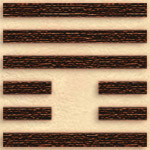
Hexagram 25 from the Yi Jing, which can be translated as 'innocence'
The I Ching is a book of divination, used to predict and plan for the future. The reader makes an enquiry about their future — for example, “What will happen if it quit my job?”, “Should I get married?”. Then they select one of the 64 chapters of the I Ching and read it to find the answer to their query.
In ancient times, the reader used a complicated system of dividing a bundle of yarrow stalks to select the relevant chapter. Nowadays people throw three coins six times. For each throw they draw a line, which is either solid or broken in two, depending on the sequence of heads and tails. The lines from six throws create a hexagram. Each hexagram relates to one of the 64 chapters of the I Ching. The person making the enquiry reads the chapter, and then tries to work out how that relates to their own question. It needs a lot of interpretation!
The I Ching has been translated into many languages, and even though it is at least 5000 years old, people still use it today to help them make decisions about their future.
