Great Wall of China
Introduction
The Great Wall of China stretches for more than 6000 kilometres, from one side of China to the other. It is about eight metres high and five metres wide.
The wall was built on the northern border of China to help protect the Chinese Empire against the “barbarians” — the non-Chinese people known as the Xiong-nu who lived in what is now called Mongolia.
Most people have seen photographs of the Great Wall as it snakes across hills and valleys. But most of the wall that is standing now was built in the Ming Dynasty (1368-1644).
This isn’t the wall that is described in Dragon Moon. The Great Wall in the Han Dynasty was a different wall — in a different place and made of different materials.
Back to top
The Qin wall
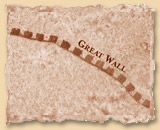
The Great Wall was first built by Qin Shi Huang, who was the first emperor of China. He conquered all the different kingdoms and formed them into one empire in 221 BCE. Soon after, he ordered the Great Wall to be built to protect his new empire.
This earlier wall was further north than the present one. A million labourers — soldiers, convicts and peasants conscripted by the government — worked on the wall.
It is estimated that for every ten labourers involved with the construction of the wall, only three lived to return home.
Back to top
Earthen wall
The wall was extended in both directions during the Han Dynasty. It was repaired and rebuilt in some places.
Most of the Ming Dynasty Great Wall is constructed of specially made bricks. During the Han Dynasty the wall was made of whatever materials were at hand. In mountain areas, stone blocks were used. On flat plains, it was made of earth.
The Han Dynasty techniques for making earthen walls resulted in very strong walls. They first built a wooden frame only about 20 cms high and filled it with earth. Then the builders rammed the earth down as hard as possible. They took away the wooden frame, leaving a solid block of earth.
On top of this block they built another frame, filled it with more earth and rammed that down. They continued on until the wall was up to 8 metres high.
Between every four layers of earth, they placed a layer consisting of bundles of reeds or palm fronds. This gave the wall added strength. The earth used to make the wall had to be free from seeds. If seeds sprouted and plants grew out of the wall it would undermine its strength.
The outer surface of the wall was made flat and smooth so that it was impossible to climb.
Back to top
Beacon towers
Along the wall were beacon towers, where imperial soldiers kept guard. If the Xiong-nu attacked, the soldiers stationed in the towers lit fires to signal to the next tower. If it was a daytime attack, they lit smoky fires. If the attack came at night, they made bright flaming fires. In this way a signal was passed along the wall so that a counter-attack could be launched.
Soldiers didn’t want to be posted on the Great Wall. It was too dangerous and too far from home. So many of the imperial soldiers who were stationed on the wall were conscripted criminals.
